


Remembering Suleiman Al-Obeid, the Palestinian Pele, Tragically Lost in Gaza
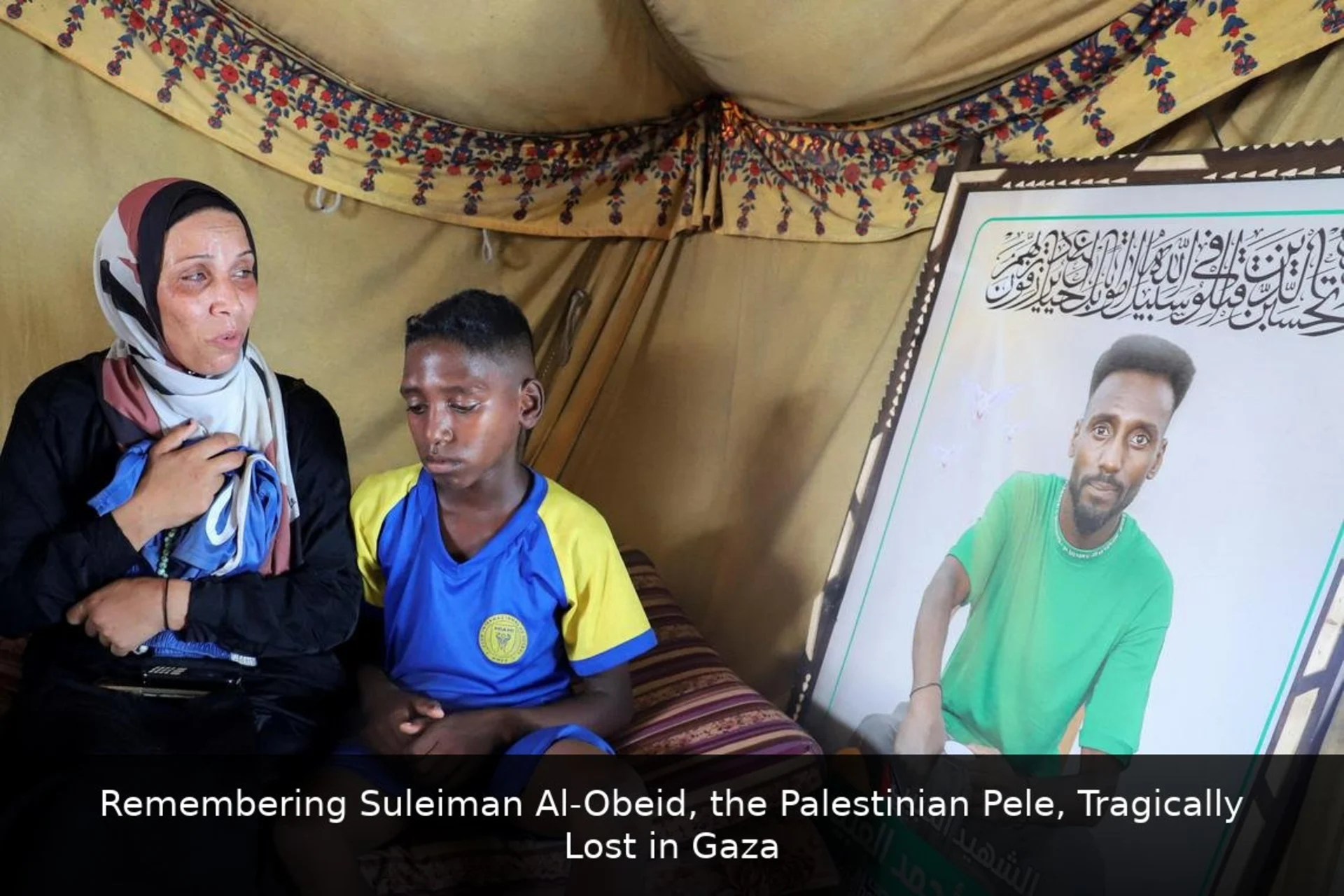
An in-depth sports feature on Suleiman Al-Obeid, the “Palestinian Pelé”, tracing his rise in Palestinian football, his domestic success in the Palestine Premier League, and the geopolitical constraints that shaped—and ultimately limited—his career, before his death in Gaza in 2021.
A football talent forged in Gaza
Suleiman Al-Obeid emerged from Gaza with a reputation that travelled faster than the political borders that defined his career. Nicknamed the “Palestinian Pelé” by supporters and local observers, he represented a rare combination of technical finesse and instinctive attacking intelligence in a football landscape often constrained by instability and limited infrastructure.
His formative years were spent in Gaza’s improvised football environment, where raw talent is often shaped more by resilience than resources. Even at an early age, Al-Obeid distinguished himself through close control, acceleration in tight spaces, and a natural eye for goal—attributes that quickly separated him from his peers and placed him on the radar of clubs across the Palestinian football ecosystem.
Breakthrough in the Palestine Premier League
The decisive step in his professional trajectory came in 2005, when he signed for Al-Am'ari Club. Competing in the Palestine Premier League, Al-Obeid delivered an immediate impact that remains one of the most efficient scoring seasons in the league’s modern history: 20 goals in 20 appearances.
That campaign was more than a statistical highlight. It signaled the arrival of a forward capable of altering the competitive balance within Palestinian domestic football. His performances powered Al-Am’ari to a third-place finish and established him as one of the most feared attackers in the West Bank circuit.
A career shaped—and constrained—by politics
As his reputation grew, so did external interest. Clubs in Israel, Jordan, and even Europe reportedly monitored his progress. Yet Al-Obeid’s career trajectory was repeatedly shaped by forces far removed from sport. Movement restrictions, administrative barriers, and the broader geopolitical fragmentation of Palestinian territory limited his ability to pursue opportunities abroad.
In many ways, his career became emblematic of Palestinian football itself: abundant talent navigating a system where logistics and politics often determine sporting destiny as much as performance on the pitch. The absence of international exposure did not diminish his domestic stature, but it undeniably constrained what might have been a wider professional breakthrough on the global stage.
Shabab Al-Khaleel and domestic success
In 2012, Al-Obeid joined Shabab Al-Khaleel, one of the most established institutions in West Bank football. His arrival coincided with an immediate competitive uplift. Leading the attack, he played a central role in securing the league title in his debut season.
Within the structure of Palestinian club football, Shabab Al-Khaleel’s success during this period reinforced the competitive hierarchy of the domestic game, while also highlighting how individual talent can still decisively shape outcomes despite broader structural limitations.
A life cut short and a global reaction
On 24 March 2021, Al-Obeid was killed in Gaza during an Israeli strike that targeted a group of people waiting for humanitarian aid. The news reverberated far beyond Palestinian football circles. Clubs, supporters, and players across the region expressed shock at the loss of a figure widely regarded as both a sporting icon and a symbol of perseverance.
His death also reignited broader debates around the vulnerability of civilians in conflict zones and the precarious intersection between sport, identity, and geopolitics in Palestine. For many within the football community, the loss was not only personal but also emblematic of a recurring tragedy: the fragility of athletic careers in environments shaped by sustained conflict.
Legacy: more than a striker in the Palestine Premier League
Al-Obeid’s legacy extends beyond goals and domestic titles. In a footballing environment where infrastructure is fragile and pathways to international competition are limited, his career stands as a reference point for what Palestinian football can produce under constraint.
For younger generations, he remains a reminder that elite-level talent can emerge from Gaza and the West Bank despite systemic obstacles. Within discussions of Palestinian football development, his name continues to surface as both inspiration and unfinished narrative—a player whose full potential was never allowed to unfold on the global stage.
In the broader context of Middle Eastern football, Suleiman Al-Obeid’s story occupies a rare space where sport, politics, and human circumstance intersect with lasting emotional weight.
Related News
How to watch the 2026 World Cup in India – live on sat
May 18, 2026
An in-depth sports journalism analysis of the unresolved 2026 FIFA World Cup broadcasting rights in India, covering FIFA negotiations, potential DD Sports free-to-air coverage, streaming platforms, past Viacom18/JioCinema strategy, and alternative VPN viewing options for fans.
Where to Watch FIFA World Cup 2026 in Nigeria - TV Channels
May 18, 2026
How to Watch FIFA World Cup 2026 in Nigeria with TV details, streaming status, match access, free-to-air notes, and World Cup 2026 schedule planning.
Remembering Suleiman Al-Obeid, the Palestinian Pele, Tragically Lost in Gaza
August 11, 2025
An in-depth sports feature on Suleiman Al-Obeid, the “Palestinian Pelé”, tracing his rise in Palestinian football, his domestic success in the Palestine Premier League, and the geopolitical constraints that shaped—and ultimately limited—his career, before his death in Gaza in 2021.
Liverpool’s Xabi Alonso dilemma exposes growing doubts over Arne Slot era as Chelsea circle former Reds hero
May 15, 2026
Liverpool’s backing of Arne Slot and Chelsea’s interest in Xabi Alonso has intensified debate over managerial direction, Premier League form, and Anfield’s long-term project.